
Crochet Pattern: Piano Key Scarf
By Rachel – 81 CommentsEDIT: This pattern was updated on December 21, 2009. The pattern as written now, uses a larger hook size (to solve the stiffness problem) and includes tips for changing colors and carrying loose ends as you work so that you will have only ONE loose end to tuck in after you complete your scarf. This pattern is intended for people with experience and lots of patience as a lot of color changes are required. This pattern is not recommended for beginners.
Please read this pattern fully and carefully before beginning. You will be required to repeat certain rows to obtain the piano key layout. Be sure to only repeat the rows indicated when instructed to.

The piano key scarf is perfect for any piano lover. Take the piano anywhere and everywhere you go. This crocheted scarf is great for men, boys, ladies and girls. No matter who you are, this scarf is bound to keep you warm and fashionably in style. Just whip out your yarn and crochet hook and follow the crochet pattern below.
Finished Size: 5’’ (13 cm) wide, and as long as you want it to be (follow the instructions within the pattern to adjust the length) |
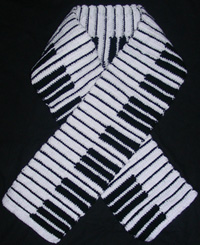
|

|
Materials: Medium Weight Yarn (Black and White) approximately 200 yards each Recommended yarn brand: Caron Simply Soft Yarn Crochet hook K (6.50 mm) Scissors |
|
Gauge:
11 sc = 3’’
6 rows = 2’’
Gauge Swatch: 3’’w x 2’’h (7.5 cm x 5 cm) ch 12.
Row 1: sc in second ch from hook and in each ch across: 11 sc
Row 2 – 6: ch 1, turn, in front loop only, sc in each sc across: 11 sc
Finish off.
How to Change Colors in this Pattern
For this pattern, when you are instructed to change colors, make one chain with the color you are currently using, then cut the yarn and pull the loop on your hook so that the loose strand of yarn is pulled through the stitch. Pull the loose strand so that it creates a small knot. Your loose end should not be longer than 2 inches. With the new color, start with a slip knot on your hook, then make the stitches as indicated in the pattern. Carry the loose end of your yarns as indicated in the tips in the pattern. The knot made should not be noticed in your work.
How to Minimize the Number of Loose Ends
The tips included within the pattern instruct you to carry loose ends of yarn by crocheting over them to minimize the number of ends you have to weave in when you finish. If done correctly you will have only ONE loose end to weave in. Here is a link to a more detailed explanation of the technique used in this pattern: How to Minimize Weaving in Ends in Crochet
Crochet Pattern: Piano Key Scarf
Row 1: with white, ch 21, working in the back ridge only, sc in second ch from hook and in each ch across: 20 sc
Tip: before making your last few stitches on this row, hold the loose end created at the beginning of the chain, to the chain and crochet over it.
All stitches now and throughout are worked in the front loop only.
Row 2: ch 1, turn, sc in each sc across: 20 sc
One Key
Row 3: ch 1, turn, sc in next 10 sc, change to blank, sc in next 10 sc: 20 sc
Tip: Carry the loose ends of the white and black yarn in your work until it is no longer sticking out.
Row 4: ch 1, turn, sl st in each sc across: 20 sl st
Row 5: change to white, turn, sc in next 10 sl st, change to black, sc in next 10 sl st: 20 sc
Tip: When crochet with white yarn at the beginning of row, carry the loose ends of the black and white yarn in your work until it is no longer sticking out. When you change to black, carry only the loose end of the black yarn in your work.
Row 6: change to white, turn, sc in each sc across: 20 sc
Tip: Carry the loose ends of the white and black yarn in your work until it is no longer sticking out. When you reach the loose end of the white yarn from the previous row, carry it in your work until it is no longer sticking out.
Work “One Key” (rows 3 – 6), 2 more times.
Space
Row 7: ch 1, turn, sc in each sc across: 20 sc
Row 8: change to black, turn, sl st in each sc across: 20 sl st
Row 9: change to white, turn, sc in each sl st across: 20 sc
Tip: Carry the loose ends of the white and black yarn in your work until it is no longer sticking out. Before making your last few stitches on this row, hold the loose ends of the black and white yarn from the previous row, to your work and crochet over it.
Row 10: ch 1, turn, sc in each sc across: 20 sc
Work “One Key” (rows 3 – 6), 2 times.
Work “Space” (rows 7 – 10), 1 time.
Work “One Key” (rows 3 – 6), 3 times.
Work “Space” (rows 7 – 10), 1 time.
Repeat the above 4 lines until the scarf is as long as you desire. When you choose to end your scarf, end after you compete your last row 7. You should only have 1 loose end to weave in when you are done.
For an extra perk, add black tassels on both ends of the scarf.
Do you need help crocheting the piano key scarf? No worries just leave a comment!


I absolutely LOVE this pattern. I have the perfect person to make it for. Do you know when you will be updating this pattern? I would really like to get started on it but I figured I would just wait until it was updated to make it easier.
Thanks for sharing your pattern.
Hi Mari, I’m working on it now, and think it should be done sometime next week.
I can’t wait for the updated pattern!! I have already started it, but it’s a bit on the stiff side
I wanted it to be a little softer, will the new pattern help? Also, do you think I can have it done by Christmas if I restart it when you update it? Thanks!
Yup, I’m redoing it so that it’s softer
It is possible for you to get it done, but it all depends on how fast you crochet.
I can work on it a couple hours a day…I only got to row 15 in an hour if that’s any indication of my speed (or lack thereof) haha. I should have splurged on a softer yarn anyway, maybe that will help with the softness. Thanks again Rachel! You are BRILLIANT!
Neat pattern!!!!!! If I start on this pattern today, will it effect my scarf once you update the pattern? Or would it be easier for me to just print out these instructions and just continue from this pattern?
I was wondering since you made this piano scarf pattern if by chance you have a neat guitar, trumpet, or both scarf patterns. I know plenty of people in the music dept. and it would be great to make some really neat scarves for them. Let me know.
Hi Mari, I don’t have a trumpet or guitar scarf pattern yet. They sound interesting to make and I’ll have to give it some thought as to how I would go about do that. Thanks for the idea!
This pattern will be similar to the updated one. For the new one, I’m going to use a different hook size, make the instructions more clear, and hopefully make it easier. With this pattern there are a bunch of ends to weave in. I’ll try to add some pointers for making it less of a hassle. My suggestion would be to wait for the new one, because you can run into all sorts of problems with the current one.
….. Or drums! I’m making the piano scarf (but now waiting for updated pattern) for one grandson, and want to make a scarf for other grandson with a drum on each end of the scarf. If anyone has seen a pattern like that, please let me know! And if I get adventurous, maybe I’ll try to figure one out. But I have never developed a pattern by myself. Which is why I REALLY appreciate the time you’re spending answering all our questions and re-writing this piano scarf pattern for us, Rachel!
Thanks a bunch. I will be checking the website daily for the new instructions. I can hardly wait to get started.
The piano key scarf crochet pattern as been posted!!
Fixes include: no more stiffness, only ONE loose end to weave in when you’re done, and clearer instructions!
Let me know if you need help
Thank you sooooooooooooo much! Merry Christmas Rachel
[...] I updated the popular Piano Key Scarf Crochet Pattern. So if you were having trouble with it, please take a look at the newly revised version. Here are [...]
Hi Rachel! the scarf is absolutely amazing.I´m going to include it among my projects.What a creative mind you have!!
Hey I’m looking forward to some patterns with other muscial instruments, especially guitar!
Thank you so much for rewriting the pattern….. I just printed it out and am so looking forward to trying it again. I got about a foot done with the original pattern, all ends tucked in(!)….. but don’t mind starting over at all since it sounds even better!
Thank you for the updated pattern and tips. I have someone in mind to make it for this year. Unless you come up with a drum!!! He plays drums in a band, Still will be making this one.
When you do the slip stitches do you continue to stitch only the first loop or do you do both?
Hi Sarah, when it says “All stitches now and throughout are worked in the front loop only.” it also includes the slip stitches.
OMG! I’m so glad I clicked on this pattern! It’s so totally cool! I’m going to have to try this ASAP!
Someday I am going to make this one! I wonder how it would look with tassels?
I made this scarf for myself because I’m a pianist and this was such a neat pattern. (Thank goodness I read your article on crocheting over the loose ends because having to weave them in would’ve been torture.) Many people complimented me on the scarf and a couple people even asked me to make one for relatives. Thank you again for such an awesome pattern!
@Geneva – I think it would look very cute with tassels!
Please….Help!!
I tried to make this scarf for my nephew (who loved the piano since age 3) when you first posted the directions last December.
I got about 6 inches done and it looked okay – kind of – but for all the loose ends!
Okay, then you revised the pattern, and I’ve since tried again – several times, but have run into some problems/questions/confusions/frustrations
For starters, which side is the right side and which is the wrong side, or doesn’t it matter? (My apologies if you specified and I missed it.)
I ask because if we’re to carry the yarn (rather than cutting at each change), it’s important to establish right side/wrong side so we don’t carry it on the wrong (incorrect) side.
Rachel — In the beginning where you give instructions for changing colors, you say the following:
“…when you are instructed to change colors, make one chain with the color you are currently using, then cut the yarn and pull the loop on your hook so that the loose strand of yarn is pulled through the stitch. Pull the loose strand so that it creates a small knot. Your loose end should not be longer than 2 inches. With the new color, start with a slip knot on your hook, then make the stitches as indicated in the pattern. Carry the loose end of your yarns as indicated in the tips in the pattern. The knot made should not be noticed in your work…”
So do we cut or carry?
Both? If so, how?
I’m really sorry, but I would so love to make this for my nephew who just turned 40. He has loved and played the piano since he was 3 years old. He will be visiting in less than 2 weeks (we’re in different states) and I was hoping to have it done by then. (Actually, I thought I’d have it done by now, but I’ve had several false starts.)
One more thing….
I assume that each row starts with chain 1, yes?
Row 5 says: “change to white, turn, sc in next 10 sl st…”
and
Row 6 says: “change to white, turn, sc in each sc across: 20 sc”
Or does the chain 1 happen during the color change?
Arghh!
I’ve been crocheting for many years, and maybe I’m not exactly advanced, but I usually get good results with even the more intricate patterns.
This one seems so easy, yet I’m having the darndest time with it.
It’s so very lovely and I know my nephew would cherish it.
Thank you in advance for any more help or clarification that you can offer.
Paulette
Paulette,
Q: You asked – “which side is the right side and which is the wrong side, or doesn’t it matter?”
A: It’s hard to tell at first, but when you past Row 8 (the slip-stitch row) and look at the differences in the two sides. The side that has the neat looking black row is the front.
Q: So do we cut or carry? Both? If so, how?
A: You will cut the end of the yarn you are finishing. Once you’ve made the knot attached the other color with a slip knot to the first stitch, you are going to hold the loose end over your first stitch (in the same space as the slip-knot) and the next few stitches so that you crochet *over* the loose end. This blog post explains it with pictures and should help you understand. – http://www.crochetspot.com/how-to-minimize-weaving-in-ends-in-crochet/
Q: I assume that each row starts with chain 1, yes?
A: When you’re working in the same color, yes. But, when you are starting another color, your first stitch removes the need for a ch-1. (The ch-1 that often comes at the end/beginning of a row helps the yarn not pull the finished piece because the sides are too tight, but when you’re starting a completely new strand of yarn at the end of the row, the ch-1 is often not necessary.)
Does this help any? I’ve tried to explain it the best I could.
Elizabeth
Thanks very much, Elizabeth for your detailed answers, but alas, I’m still not clear.
I guess it’s me. You say until row 8, we don’t know which is right side/wrong side, so should we not carry any yarn on either side for 8 rows?
And I’m still confused about the cutting and/or carrying. If we cut the yarn to change colors, then we’re not carrying the ‘old’ yarn for the next color change, are we?
I’m sorry, but I’m just not getting it.
Thanks again, Elizabeth. I really appreciate your efforts.
Maybe I just need to look for a different project. As pretty as this one is, it’s just causing me too much frustration.
Paulette
Paulette, when you carry your yarn you do not have to put it on a certain side (right or wrong). Carrying is referring to crocheting over the yarn. Look in the link that Elizabeth provided. In this pattern, it is used to hide your ends. If you cut the yarn, you are no longer carrying it. Use the instructions within the pattern to know when to carry and when not to.
Maybe I’m just misunderstanding what you mean by “carrying”.
I get the part about changing colors at the beginning/end of rows, but when you change colors in the middle of the row, do you also cut off the yarn that you’re changing FROM?
I thought the idea of “carrying” was because of the frequent color changes, in which case it would be important to know right side/wrong side early on.
And when you change colors in the middle of the row, do you also cut and pull through the loop on hook or do you pick up the new color with the last part of the stitch?
I really want to understand and I really would love to make this scarf, but again, I’m still not clear on these parts of the directions.
Thank you in advance – for your help, and most of all, for your patience.
Paulette, carefully read the instructions at the beginning that discussion how to change colors in this pattern. It is a bit different from what you may be used to. It discusses the steps in changing colors and cutting the yarn. This pattern is specially designed so that you will only have 1 end to weave in when you are done.
Reply to Rachel @7:28:
Do those instructions apply to changing colors in the middle of the row also? (i.e.: cuttiing, pulling through to make small know, slip knot on hook with new color, etc.)
Instructions say:
“For this pattern, when you are instructed to change colors, make one chain with the color you are currently using, then cut the yarn and pull the loop on your hook so that the loose strand of yarn is pulled through the stitch. Pull the loose strand so that it creates a small knot. Your loose end should not be longer than 2 inches. With the new color, start with a slip knot on your hook, then make the stitches as indicated in the pattern. Carry the loose end of your yarns as indicated in the tips in the pattern. The knot made should not be noticed in your work.”
If we do this in the middle of the row, we (I) lose continuity.
Yes, the instructions are for each time you change colors in the pattern. It does not matter if you lose continuity, you will rejoin the yarn later and only have 1 end to weave into your work when you are done, if the instructions are followed carefully. This is the way that I designed this pattern. If you would like to do it your own way, feel free.
Oh wow! I recently finished a knitted piano key scarf much like this one but with a boarder. It is neat to see someone else’s version.