Tutorials and Help

How to Crochet on Opposite Side of Chain

Posted in Tutorials and Help on November 3rd, 2009 by Rachel – 2 Comments

Crocheting in the round is a very useful technique when you want to make bags, hats and other round objects. In this tutorial I will show you how you can crochet around a foundation chain. This method is used a lot in my crochet patterns to prevent having to sew your project together.

This tutorial is for both right and left handed people. For left handed pictures, roll your mouse over the image and it will change for you.

Start by crocheting a foundation chain. If you are working with a pattern, it will tell you how long to make this chain.


read more »

5 Tips to Prevent Yarn from Splitting While You Crochet

Posted in Tutorials and Help on October 29th, 2009 by Rachel – 2 Comments

It is really annoying when you crochet and your yarn splits! You end up with only part of the strand of yarn on your hook instead of the entire strand. Here are some tips to help you prevent your yarn from splitting while you crochet:

  1. Use a bigger hook – The bigger your hook, the less chance that your hook will split your yarn. Smaller hooks are more pointy and tend to “stab” your yarn in half. While bigger hooks obviously have a larger hook to grab you strand of yarn without splitting it.
  2. Take your time – If you take your time, and move extra slow when you crochet, there is no way you can split your yarn. Try working in slow motion for a few stitches and be sure that your yarn is properly under your hook before you pull it. You can speed up, once you get the hang of it.
  3. Work with the opposite end of the yarn – Yarn is made with a bunch of plies of yarn twisted together. Sometimes your yarn splits because you are working against the direction that the yarn is twisted in, so you are basically untwisting it. By working with the opposite end of the yarn you can work into the same direction that the yarn is twisted in, so that it doesn’t split.
  4. Use a different brand – Different hooks made by different companies are shaped differently. There isn’t one hook that is great for everyone, so try out different types of hooks to see which one works best for you. Be sure to try out different brands of yarn as well.
  5. Practice – Practice makes perfect, as the old saying goes, and it is so true. I remember when I first started crocheting, my yarn would split all the time. But now, using the exact same hook and brand of yarn, it doesn’t split anymore because I have practice crocheting. So just be patience and practice, you can do it!

Do you have a tip to prevent yarn from splitting that you would like to share?

Scrap Yarn for Bird Nests

Posted in Tutorials and Help on October 20th, 2009 by Rachel – 12 Comments

There are many things you can do with your scrap yarn, but if you’re like me, you feel guilty for throwing it out (even if it is just a really small scrap). Here is an idea that I’ve heard lots of people talk about!

Some people put out bird feeders for the birds, but why not put out materials for the birds to build their nests with too? You can create a “bird nest kit”. To do so, use a small netted bag (like the plastic ones you get oranges or onions in), and place your scraps of yarn inside. You can also use other containers that have large enough holes for the birds to peck through. Hang it on a tree so that the birds can take materials as they need it.

Here are some pictures of bird nest kits:

scrap yarn bird nest kit scrap yarn bird nest kit scrap yarn bird nest kit

The first 2 pictures are from funinthemaking.net. The last picture is from a seller on Etsy.com: “Maddy & Me”

As you can see, you can get very creative in creating a bird nest kit with your scrap yarn!
I was also wondering if these bird nest kits would be safe for birds and the environment. What do you think and have you tried it?

How to Find the End of the Yarn in a Pull Skein

Posted in Tutorials and Help on October 13th, 2009 by Rachel – 4 Comments

Lots of skeins of yarn these days are rolled up so that one end of the yarn runs through the middle of the skein. Although it is sometimes easier to find the end of the yarn that is on the outside of the skein, using the end on the inside has its advantages. Using the center end will not cause your skein to roll all over the place when you crochet or knit and you will not have to put down your work to unravel the yarn.

However, the middle end of the yarn maybe be hard to find! Here are 3 easy steps to find the center strand of the pull skein:

  1. Insert your thumb and index finger of one hand into the center of the skein. Do the same with your other hand, entering it into the opposite side of the skein.
  2. Squish the skein so that your fingers can touch. Feel around to find the very center of the skein.
  3. Pull the center of the skein out with one hand. (you will pull out extra yarn with it, but the end of the skein should be there too)

Before you begin crocheting with the center end of your skein, make sure that the outside end of the yarn is visible too. Sometimes the outside end is tucked into the skein, but this can cause it knot up if you don’t pull it out before your start working.

Yarn Containers

Posted in Tutorials and Help on October 10th, 2009 by Rachel – 15 Comments

Keeping your yarn clean and traveling with it can be a hassle without a proper container or bag to put your work in. There are some clever containers that you can make at home by reusing / recycling materials.

The basic idea is to use a container and poke a hole at the top so that your strand of yarn can go through it. You can use any container you like, such as an old storage container, food container, or small canister. If your container is big enough you can also store your hooks and pattern sheet in it too!

Here are some examples of yarn containers:

These containers I found at instructables.com. They have a tutorial there for making these yarn containers as well. Looks like they just used good old food containers.

yarn containers

This container I found at Drenka’s Blog. She used an old plastic container that used to hold spices and even decided to decorate the container with a ribbon.

yarn container

There are also yarn containers that you can buy in the store if you’re not into doing it yourself. They are nicely designed in different sizes and come with a handy handle. (Err..that should be a crochet hook in the picture)

yarn container

Do you have a yarn container idea you would like to share?

Where is the Back Ridge of a Chain in Crochet?

Posted in Tutorials and Help on September 29th, 2009 by Rachel – 5 Comments

There are a few ways to crochet into your foundation chain. The most common way is to insert your hook under the top loop on the front of the chain. However, you may want to insert your hook in the back ridge of a chain instead. Where is the back ridge?

Here is a picture of the front of several chains.
crochet chain
Here is a picture of the back of the chains. The back ridge is the small “hump” on the back of the chain.
back ridge
Why crochet into the back ridge?
Symmetry – the beginning of your work will look more like the end of your work. The 2 loops of the chain that look like the front and back loops of a stitch will appear at the beginning of your work.

Do you have a question about the back ridge of a chain stitch? Or do you have info you would like to share? Leave a comment!

5 Quick Crochet Tips for Beginners

Posted in Tutorials and Help on September 3rd, 2009 by Rachel – 8 Comments
  1. Pick the right color to work with. When you first start crocheting certain colors of yarn make it easier to see the stitches and others make it dreadfully hard. Try to avoid using very dark colored yarns such as black and very light light colored yarns such as white.
  2. Pick the right type of yarn. You don’t need fancy yarn when you first learn to crochet. In fact the facy yarns such as eyelash yarn and boucle will make it harder for you to learn and see your stitches. Stick to ordinary, simple and cheap yarn.
  3. Use a big hook. Bigger hooks make it easier to see stitches. As you may notice by now, being able to see the stitches is a big part of learning to crochet.
  4. Have fun. So what if this sounds cheesy. Don’t crochet if you’re not having fun doing it! Studies show that crocheting is actually good for your health, but if it’s stressing you out, it’s probably a good idea to take a break.
  5. Ask Rachel (me) for help. Don’t be ashamed to ask for help if you need it. I won’t bite. There’s nothing more dreadful than being frustrated over something hard to understand (I’ve been there). You can also find more help in the Crochet Tutorials section.

Do you have a crochet tip for beginners to share?

How to Crochet Edging onto Clothing

Posted in Free Crochet Patterns, Tutorials and Help on August 27th, 2009 by Rachel – 5 Comments
Do you have old clothes that are boring and you don’t wear anymore? If so, here is a way to spruce them up and give them a brand new look! You can add crocheted edging to your shirts, sleeves, skirts or any other piece of fabric you wish.

In this example, I transform the plain neckline of my old shirt into pretty crocheted edging using a simple edging pattern. Remember, you can do this for all sorts of fabric using different edging patterns. Use this example as a guide for the edging you choose to crochet onto your clothing.

crochet edging

Materials:
Old T-shirt or other fabric
Scissor
Size 10 thread (you may use other threads or weights of yarns if desired)
Crochet Hook US 7 (1.5 mm)
Note: Use a hook that is appropriate for the thread/yarn you chose to use. The smaller the hook the easier it is for it to pierce the fabric. (Learn more about types of yarn and recommended crochet hooks)
Optional: If your hook is not able to pierce through the fabric you may use a darning needle or other sharp tool to pre-poke the holes into your fabric
read more »

Learning to Crochet

Posted in Rachel's Ramblings, Tutorials and Help on August 12th, 2009 by Rachel – 6 Comments
When I was in middle school, I saw one of my closest friends crocheting and I thought it was so amazing! The way a ball of yarn was being turned into a piece of cloth was definitely stare worthy. I ended up going home to ask my mom how to crochet and if I remember correctly she taught me how with a chopstick. Yea, we didn’t have a crochet hook and I really wanted to learn how.

I learned the basic foundation chain, single crochet and double crochet. At the time technique and making things look perfect wasn’t a priority so I learned those skill as I went along. I was just so excited about all the things that I wanted to make!

Today I’m pretty sure that I know more about crocheting than my mom who taught me, since I’m always learning something new from people, books and crochet tutorials online. So if you’re just learning to crochet, here are some basics to start with:

How to Hold a Crochet Hook
How to Hold Yarn in Crochet
How to Crochet: Slip Knot
How to Crochet: Chain (ch)
How to Crochet: Single Crochet Stitches (sc)
How to Crochet: Double Crochet Stitches (dc)

Don’t worry too much about perfection, it’ll come with experience. But here are “7 Tips to Establish Consistency in Crochet” if you feel you need them. Also, feel free to dig into the Crochet Tutorials Archives for more How-To’s!

Do you have a crochet learning experience to share?

Why Tunisian Crochet Curls and How to Get Rid of It

Posted in Tutorials and Help on August 9th, 2009 by Rachel – 2 Comments

Tunisian crochet (also know as afghan stitch) curls, it’s natural. If you’re curious, here is the easy answer to why Tunisian crochet curls:

Tunisian crochet curls because of physics! Unlike ordinary crochet where the stitches are located on the top of the work, Tunisian stitches are located on the front of the work. Every time you make new stitches, they are slightly forward and not exactly on the top of your previous row. This is why your work will end up curling forward.

To uncurl Tunisian Crochet, here are some helpful tips:

  1. Blocking. In my opinion this the best thing to do. Blocking crochet is the one simple step to “mold” your work into the way you want it. Whether you choose to steam it with an iron or wet it and let it dry, blocking can be fast and easy to do. Learn more about Blocking Crochet.
  2. Use a bigger hook. Larger hooks reduce the amount of tension in your work. The less tension, the less curl there will be.
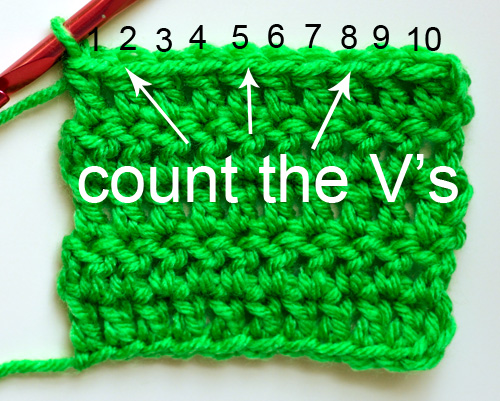
  3. Alter foundation chain. Try turning your foundation chain upside down and pull up your loops into the back ridge of each chain instead. The back ridge is located behind the two loops of the chain that makes the “V” shape.
  4. Use different stitches. Purl stitches are know to create less curl than other Tunisian stitch. By varying the types of stitches that you use, it can reduce the curl.

In my experience, blocking works the best! Do you have a tip to share?
If you want to learn Tunisian crochet, get started by learning How to Crochet Tunisian Simple Stitch.